TL;DR / Key Takeaways
Medical tourism lead management software is a purpose-built system that captures, scores, routes, and follows up on every patient inquiry an agency receives — from web forms to WhatsApp to Instagram DMs — so no lead sits unanswered.
Firms that respond to a new inquiry within five minutes are roughly 21 times more likely to qualify that lead than firms that wait 30 minutes, according to research popularized by Harvard Business Review — yet the average business still takes over 40 hours to reply.[^1]
A generic sales CRM can log contacts, but it doesn't understand medical records, procedure quotes, multi-country logistics, or HIPAA-adjacent data handling — which is why a dedicated medical tourism patient tracking system consistently outperforms spreadsheets and generic tools.
The nine features below — lead scoring, omnichannel capture, automated follow-up, quote-to-booking pipelines, and more — are what separate agencies converting 25–35% of qualified leads from agencies still converting under 10%.
We built this guide from our own work helping medical tourism agencies and facilitators replace spreadsheets and inboxes with a real medical tourism management tool.
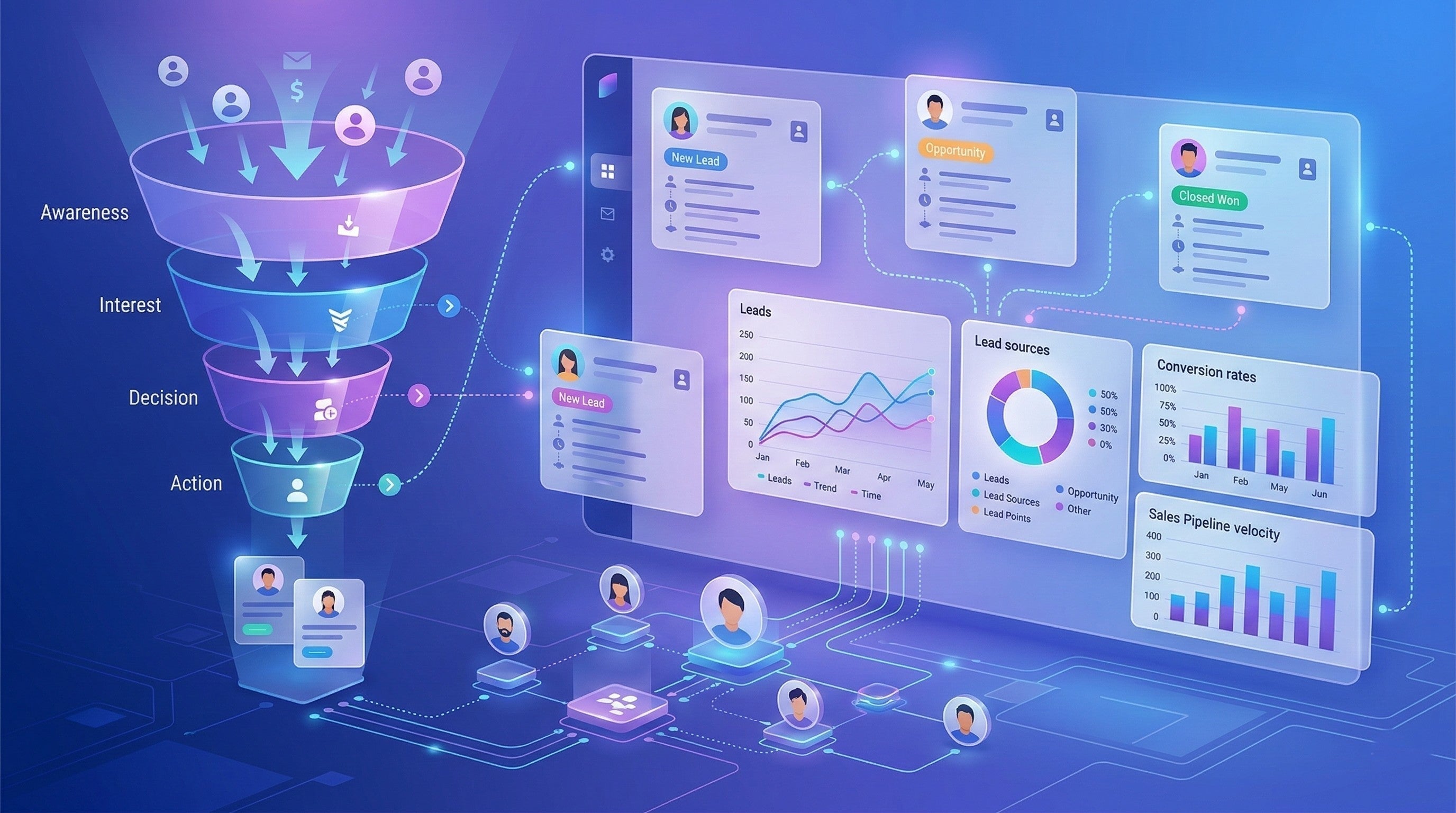
Alt text to use: "medical tourism lead management software dashboard" — replace the placeholder above with an actual screenshot of your platform before publishing; a real product screenshot outperforms stock photography for both SEO and reader trust.
If you run a medical tourism agency, you already know the feeling: a promising inquiry comes in through Facebook, your coordinator answers three others first, and by the time anyone replies, the patient has already booked with a competitor. That scenario is the entire reason medical tourism lead management software exists. It is software built specifically to capture every patient inquiry the moment it arrives, score it based on procedure and destination fit, and make sure a human follows up before the patient's interest cools off. In this guide, we'll walk through what this software actually does, why generic CRMs fall short for health tourism specifically, and the nine features we believe are non-negotiable for any agency serious about growth in 2026.
What Is Medical Tourism Lead Management Software?
Medical tourism lead management software is a platform that centralizes every patient inquiry an agency receives — across web forms, WhatsApp, email, Instagram, and referral partners — into one pipeline, then automates scoring, routing, and follow-up so no inquiry is lost. Unlike a general sales CRM, it's built around the specific shape of a medical travel case: a patient describes symptoms or a desired procedure, an agency matches them to a partner hospital or clinic, a quote gets built, documents get collected, and the case eventually converts into a booked trip. A generic lead tool has no concept of any of that. A purpose-built system does.
Think of it as the layer that sits between "someone filled out a form asking about knee replacement in Mexico" and "that person is on a plane." Everything that happens in between — qualification calls, quote revisions, passport and visa checks, follow-up reminders — lives in one record instead of scattered across email threads, WhatsApp chats, and a spreadsheet someone forgot to update.
Why Medical Tourism Agencies Lose Leads Without One
Most agencies don't lose leads because they lack demand. They lose leads because of process gaps that a spreadsheet or shared inbox cannot fix. Three patterns show up again and again.
Response time kills conversion. The research is consistent across industries: contacting a lead within the first five minutes makes a company roughly 21 times more likely to qualify that lead compared to waiting 30 minutes, and up to 100 times more likely to even make contact at all, according to the widely cited MIT/InsideSales.com lead response study referenced by Harvard Business Review.[^1] The same research found that 78% of customers ultimately buy from whichever company responds first — not the cheapest, not the most credentialed, simply the fastest.[^1] In healthcare specifically, average response time sits around two hours, while the ideal window is under ten minutes.[^2] For a medical tourism agency juggling inquiries across three or four time zones, that gap is where revenue disappears.
Leads fall through channel silos. A patient might message on Instagram, then email a follow-up question, then call the office line. Without a system that merges those into one record, three different coordinators can end up responding — or worse, nobody does, because each assumes someone else has it.
There's no visibility into where a case actually stalled. Did the patient go cold because pricing was too slow to arrive? Because nobody followed up after the quote? Because the intake form asked for medical records too early? Without a medical tourism patient tracking system logging every stage, agency owners are guessing instead of fixing the actual leak in their funnel.
Medical Tourism Lead Management Software vs. Generic CRM vs. Spreadsheets
Agencies typically start with a spreadsheet, graduate to a generic CRM like a sales tool built for SaaS companies, and eventually realize neither was built for how a medical travel case actually moves. Here's how the three options compare on the things that matter most to a facilitator or agency owner.
Capability | Spreadsheet / Shared Inbox | Generic Sales CRM | Medical Tourism Lead Management Software |
|---|---|---|---|
Captures leads from WhatsApp, Instagram, web forms automatically | No | Partial, requires custom setup | Yes, built-in |
Understands procedure type, destination, and hospital matching | No | No | Yes |
Builds and revises multi-line procedure quotes | No | No | Yes |
Tracks documents (passport, medical records, consent forms) per patient | No | Limited | Yes |
Automated follow-up sequences by lead stage | No | Yes, generic | Yes, tuned to patient journey |
Lead scoring based on procedure value and destination fit | No | Generic scoring only | Yes |
Data handling built with patient-sensitive information in mind | No | No | Yes |
Reporting on where cases stall in the medical tourism funnel | Manual | Generic sales stages | Yes, stage-specific |
The middle column is worth pausing on. A medical tourism management tool doesn't have to be more expensive or more complex than a generic CRM — it just has to be shaped around the actual case, not a generic sales pipeline that assumes you're selling software subscriptions instead of coordinating international surgery.
9 Must-Have Features of a Medical Tourism Lead Management Software
We've grouped these into the features that consistently separate agencies with healthy conversion rates from agencies still losing patients to slow follow-up.
1. Omnichannel Lead Capture
Patients don't wait to find your contact form. They message on WhatsApp Business, comment on an Instagram ad, fill out a landing page, or get referred by a past patient via email. Good software pulls every one of those into a single lead record automatically, timestamped, with the original message intact. If your team is manually copying WhatsApp screenshots into a spreadsheet, you're already behind.
2. Automatic Lead Scoring
Not every inquiry is equal. A patient asking about a $15,000 cardiac procedure with clear intent to travel within two months is worth prioritizing over someone browsing prices with no timeline. A medical tourism lead management software platform scores leads automatically based on procedure value, destination interest, urgency signals in the message, and engagement history — so coordinators know who to call first without guessing.
3. Automated Follow-Up Sequences
Given that 78% of patients go with the first business that responds, automated first-touch messages (even a simple "we received your inquiry and a coordinator will call within the hour") matter enormously.[^1] Beyond the first response, a sequence of scheduled follow-ups — day 1, day 3, day 7 — catches the patients who didn't answer the first call, which research shows is most patients on the first attempt.
4. A Real Medical Tourism Patient Tracking System
This is the core of the platform: a single record per patient that tracks every stage of the journey — initial inquiry, qualification call, quote sent, documents collected, deposit paid, travel booked, procedure completed, follow-up care. A proper medical tourism patient tracking system means any coordinator can open a case and immediately know exactly where it stands, instead of digging through email chains.
5. Quote and Package Builder
Medical travel quotes are rarely one line item. They typically bundle the procedure cost, hospital fees, accommodation, airport transfers, and sometimes a companion package. Software that lets coordinators build, revise, and send these quotes directly from the lead record — instead of building them fresh in a document each time — cuts the time between inquiry and quote dramatically, which matters given how fast interest fades.
6. Document and Compliance Tracking
Passports, visa documentation, medical records, and consent forms all need to be collected, verified, and stored per patient before travel can be booked. A checklist attached to each patient record — with reminders for missing items — prevents the common failure mode where a case is "ready to book" except nobody noticed the passport was never uploaded.
7. Multi-Language and Multi-Currency Support
International patients arrive speaking different languages and thinking in different currencies. Software that can display quotes in a patient's home currency and support templated messages in multiple languages removes friction at exactly the point where patients are deciding whether to trust an unfamiliar agency with a major medical decision.
8. Pipeline and Funnel Reporting
An agency owner needs to see, at a glance, where leads are stalling: is it the qualification call, the quote stage, or the gap between deposit and booking? Reporting broken down by stage — not just "total leads this month" — is what turns a medical tourism management tool from a filing cabinet into an actual growth lever.
9. Partner and Hospital Coordination Tools
Once a case is qualified, someone has to coordinate with the receiving hospital or clinic — confirming availability, sharing medical records securely, and getting written cost confirmations. Software that lets agencies manage these hospital-facing threads inside the same platform (rather than a separate email inbox per partner) keeps everything auditable and searchable months later when a patient asks a follow-up question.
How a Medical Tourism Patient Tracking System Improves Conversion
The connection between tracking and conversion is straightforward but easy to underestimate. When every patient interaction lives in one record, three things happen. First, response time drops, because any available coordinator can see the full history and respond immediately instead of waiting for "the person who was handling that lead" to come back online. Second, nothing gets forgotten — automated reminders catch the quote that was sent but never followed up on, which is one of the most common places agencies lose otherwise-ready patients. Third, owners get real data. Instead of a gut feeling that "leads have been slower this quarter," a proper medical tourism patient tracking system shows exactly how many inquiries came in, how many were qualified, how many got a quote, and how many converted — the same funnel discipline that high-performing B2B sales teams have used for years, adapted to a patient journey that includes medical records instead of contract redlines.
It's also worth being honest about what a tracking system does not replace. It doesn't replace a knowledgeable coordinator, and it doesn't replace due diligence on the receiving hospital's accreditation and outcomes. The U.S. Centers for Disease Control and Prevention notes that care standards, infection control practices, and facility licensing requirements vary significantly by destination country, and that patients should have a pretravel consultation with a healthcare provider well before departure.[^3] Good software supports that vetting process by keeping hospital credentials and outcome data attached to each partner record — it doesn't substitute for the vetting itself.
How to Choose the Right Medical Tourism Management Tool for Your Agency
With the market growing quickly — global medical tourism spending is estimated in the tens of billions of dollars for 2026 by multiple industry analysts, with strong double-digit annual growth forecast through the early 2030s[^4] — more software vendors are entering the space, and not all of them understand the workflow. A few questions worth asking before you commit:
Does it handle omnichannel intake out of the box, or will you need custom development to connect WhatsApp and Instagram?
Can coordinators build a multi-line procedure quote inside the tool, or will they still be exporting to a separate document?
Does reporting break down by the actual medical tourism funnel (inquiry → qualified → quoted → deposited → booked → traveled), or only by generic sales stages that don't map to your process?
How does it handle sensitive patient data, including medical history and passport information, given the compliance expectations that come with handling health information across borders?
Can it grow with you from a two-person facilitator operation to a team coordinating hundreds of cases a month, without forcing a platform migration later?
We'd argue the single biggest differentiator is whether the software was actually built for medical tourism, or retrofitted from a generic CRM template. Our own buyer's guide to medical tourism software</a> goes deeper into evaluating vendors if you're comparing multiple options.
Common Mistakes Agencies Make With Lead Management
Even with the right software, a few recurring habits undercut results. Agencies often treat every inquiry the same regardless of procedure value or urgency, instead of prioritizing the leads most likely to convert quickly. Many rely on a single coordinator checking a shared inbox rather than automated routing, which creates a bottleneck the moment that person is unavailable. Others collect a lead's information but never build a structured, repeatable follow-up cadence, so interest fades exactly at the moment research says it's most fragile — the first hour after inquiry.[^1] Finally, some agencies track leads informally in someone's head or a personal notebook, which means institutional knowledge walks out the door the moment that coordinator leaves.
What This Looks Like in Practice
Picture two agencies, both running Facebook ad campaigns for orthopedic procedures in Turkey. Agency A collects inquiries in a shared Gmail inbox and a spreadsheet a coordinator updates when she remembers. Agency B runs everything through a medical tourism lead management software platform. A patient fills out a form asking about hip replacement pricing at 9:14 p.m.
At Agency A, the inquiry sits overnight. A coordinator sees it the next morning at 9:30 a.m., twelve hours later, and replies with a generic price range. The patient, who had already messaged two competing agencies the night before, has booked a consultation call with one of them by the time Agency A's email lands.
At Agency B, the same inquiry triggers an automatic first-touch WhatsApp message within two minutes confirming receipt and giving a rough price range instantly. The lead is scored as high-value based on procedure type and routed to the on-call coordinator, who calls within the hour. The patient's full message history, procedure interest, and scoring are already visible in one record before the coordinator even picks up the phone. Nothing here required a bigger team or a bigger ad budget — it required a system that didn't let a twelve-hour gap happen in the first place.
This is the practical difference between having software and having a system. The features matter less individually than they do as a connected pipeline: capture, score, respond, track, quote, close.
Doing the ROI Math
It's worth running the numbers on your own funnel before dismissing a medical tourism management tool as an unnecessary expense. Say your agency generates 150 qualified inquiries a month, your average completed case is worth $6,000 in facilitator margin, and you currently convert 8% of qualified leads because response times average several hours. That's 12 booked cases and $72,000 in monthly margin.
Industry lead-response research suggests that moving from a multi-hour average response time to a sub-five-minute response, paired with structured follow-up, can plausibly double or triple conversion rates for inbound leads — a pattern documented across B2B and consumer-facing industries alike, where near-instant response has been shown to lift conversion by several multiples compared to delayed follow-up.[^1] Even a conservative jump from 8% to 14% conversion on the same 150 leads adds nine additional bookings a month — worth roughly $54,000 in additional monthly margin, using the assumptions above. Software that costs a few hundred dollars a month pays for itself many times over the moment it prevents even a handful of leads from going cold.
What to Expect During Implementation
Switching from spreadsheets to a dedicated platform is usually faster than agency owners expect, but it's worth planning for a few weeks of transition rather than an overnight flip. Most agencies start by migrating existing active cases — not historical closed leads — so coordinators aren't managing two systems in parallel for long. Connecting WhatsApp Business and any web forms is typically the first technical step, since that's where the majority of new inquiries originate. From there, agencies build out their scoring rules (which procedures and destinations count as high priority) and their follow-up sequences before turning on full automation. Teams that skip the rule-setup step and just "turn on" software without configuring it for their specific procedures and destinations tend to be disappointed with the results — the software is only as good as the workflow it's modeled on.
Frequently Asked Questions
What is medical tourism lead management software used for? It's used to capture patient inquiries from every channel, score and prioritize them, automate timely follow-up, and track each case from first contact through booked travel — replacing spreadsheets, shared inboxes, and generic sales tools that weren't designed for the medical travel journey.
Is a medical tourism patient tracking system different from a hospital's electronic medical record (EMR)? Yes. An EMR is the clinical record maintained by the treating hospital or clinic. A patient tracking system used by an agency or facilitator manages the pre-travel journey — inquiry, quoting, document collection, logistics, and coordination — and is not a substitute for clinical recordkeeping.
How much does medical tourism lead management software typically cost? Pricing varies by vendor and by the number of coordinators using the platform, but most purpose-built tools are priced per user per month, similar to standard CRM pricing models, rather than as a flat enterprise license.
Can a generic CRM work instead of a dedicated medical tourism management tool? It can work in a limited sense — a generic CRM will log contacts and basic follow-up tasks — but it typically requires significant custom configuration to handle procedure-based quoting, document tracking, and hospital coordination, which purpose-built tools include natively.
How quickly should a medical tourism agency respond to a new inquiry? As close to immediately as possible. Industry research on lead response consistently shows that qualification odds drop sharply after the first five minutes, and that the majority of customers convert with whichever provider responds first.[^1] Automated first-touch messages, followed by a live call within the hour, are the practical minimum for a competitive agency in 2026.
The Bottom Line
Medical tourism is a relationship business built on trust, but trust starts with responsiveness. An agency can have the best hospital partnerships and the most competitive pricing in the industry and still lose patients simply because nobody replied fast enough. Medical tourism lead management software exists to close that gap — turning scattered inquiries into a tracked, prioritized, and followed-up pipeline. If you're currently running your agency out of a shared inbox and a spreadsheet, the features above are the ones we'd prioritize first when you're ready to make the switch.
We built MedicalTourismCRM specifically around this workflow — from omnichannel intake to quote building to patient tracking — because we saw too many good agencies losing patients to process gaps, not to competition. You can see how the platform handles each of the features above on ourhomepage.
Run your medical tourism agency on one platform
Leads, pipeline, travel, pricing, chat and email marketing — live in a day, no credit card required.
Start your free trial